


Strict Standards: Declaration of McalendarControllerMCalendar::display() should be compatible with McalendarController::display($cachable = false, $urlparams = false) in /home/nrnvguvu78sn/public_html/components/com_mcalendar/controllers/mcalendar.php on line 0
Strict Standards: Only variables should be passed by reference in /home/nrnvguvu78sn/public_html/components/com_mcalendar/controllers/mcalendar.php on line 22
Strict Standards: Only variables should be passed by reference in /home/nrnvguvu78sn/public_html/components/com_mcalendar/controllers/mcalendar.php on line 23
Strict Standards: Only variables should be passed by reference in /home/nrnvguvu78sn/public_html/components/com_mcalendar/controllers/mcalendar.php on line 24
Strict Standards: Only variables should be passed by reference in /home/nrnvguvu78sn/public_html/components/com_mcalendar/controllers/mcalendar.php on line 25
Strict Standards: Only variables should be passed by reference in /home/nrnvguvu78sn/public_html/components/com_mcalendar/controllers/mcalendar.php on line 26
Notice: Undefined property: stdClass::$name in /home/nrnvguvu78sn/public_html/components/com_mcalendar/models/shrines.php on line 17
Related Books
Madonna del Pilar (Castenaso, Italia)
Notice: Undefined property: stdClass::$state in /home/nrnvguvu78sn/public_html/components/com_mcalendar/views/detail/tmpl/default.php on line 95
Castenaso, Italy (1699)
Commemorated on January 27

On January 27, 1699, a young woman passes in front of the church and hears a mysterious voice that clearly says, "Mary Magdalene, will you not continue with your devotion to the Madonna?".
She goes to church, clasps her hands on her chest, goes close to the image of Mary, prays, and the Madonna lovingly takes her hand and rasks that she always be devoted to her.
History
Castenaso is a town 11 kilometers from Bologna is the capital of Emilia-Romagna, whose origins date back to the early centuries of the Christian era.
Castenaso is a small town six miles outside Bologna on the Idice River. The chapel of Santa Maria delle Tombe (St. Mary of the Tombs), built in 1315, came into the possession of the Spanish College of Bologna some 50 years later. In 1672 a painting by Giambattista Bolognini was hung in the chapel, depicting Our Lady of the Pillar, the famous Black Virgin of Saragossa, Spain, with St. James the Greater and St. Peter Arbues, an alumnus of the college. On January 27, 1699, Maria Maddalena Azzaroni, oldest of five children, hurried by the chapel on her way to borrow some oil from her aunt, without stopping to say her customary prayer at the spot. Hearing a voice say, "Maria Maddalena, have you given up your devotions to the Madonna?" she went back and prayed before the image. The Madonna came out of the painting, holding out her hands, and asked the girl to remain always devoted to her. Four years later, when the Church had approved the miracle and built a baroque sanctuary there, Maddalena entered a convent.
Castenaso is a small town six miles outside Bologna on the Idice River. The chapel of Santa Maria delle Tombe (St. Mary of the Tombs), built in 1315, came into the possession of the Spanish College of Bologna some 50 years later. In 1672 a painting by Giambattista Bolognini was hung in the chapel, depicting Our Lady of the Pillar, the famous Black Virgin of Saragossa, Spain, with St. James the Greater and St. Peter Arbues, an alumnus of the college. On January 27, 1699, Maria Maddalena Azzaroni, oldest of five children, hurried by the chapel on her way to borrow some oil from her aunt, without stopping to say her customary prayer at the spot. Hearing a voice say, "Maria Maddalena, have you given up your devotions to the Madonna?" she went back and prayed before the image. The Madonna came out of the painting, holding out her hands, and asked the girl to remain always devoted to her. Four years later, when the Church had approved the miracle and built a baroque sanctuary there, Maddalena entered a convent.
The name is due to the fact that in the year 186 BC, the Roman consul Publio Cornelio Scipione Nasica installed his camp on the right bank of the river Idice, facing the camp of the Gauls. Hence the name "Castrum Nasicae" Nasica camp, which then led to Castenaso.
The same coat of arms in 1852 Castenaso shown in the center denoting an amphora Idice the stream, right on the Roman camp surrounded by a fence with eagle emblem of the Roman legion, in fente, the Gallic camp, with pica under the horse's head, then the shield, short sword hilt cross necklace formed with two ropes twisted the Gauls' necks, and the big brass ring that used to use the arm near the shoulder. The Gauls had defeated the Romans in Litana Forest, but defeated them in 186 BC Nasica
Castenaso passed by celebrities: Carlo Magno, who came from Ravenna, May 29 801, Pope Pius IX in 1857 and Garibaldi in 1859.
Source:
(Information from Maria di Nazareth, www.mariadinazareth.it/apparizione%20castenaso.htm. Photo from Marcello Mamini, "eutanasia di un amore," Il piacere di leggere, www.ilpiaceredileggere.it.)
http://www.wherewewalked.info/feasts/01-January/january_27.htm
http://forosdelavirgen.org/500/nuestra-senora-del-pilar-de-castenaso-italia-27-de-enero/
Description
Three kilometers south of the place, the shrine of Our Lady of Pilar arises, or as popularly called the "Pilaro". In 1315 there was a small church dedicated to the Holy Virgin, called St. Mary's Tomb or the Snow that happened next, with adjacent land, property of the Spanish School of Bologna, founded in 1364 by Cardinal Albornoz.
The small church then changed her name because it was placed in 1672 a painting by GB Bolognini, representing Our Lady of Pilar next to the apostle Santiago and San Pedro de Arbués martyr, a student of the College of Spain.
Devotion to Our Lady of Pilar goes back to the origins of Christianity. A tradition supported by testimonies of the time and tested and confirmed with numerous privileges of the Popes, says the glorious apostle James, inspired by the Holy Spirit of Jerusalem comes to Spain to preach the Gospel. In Zaragoza, the Ebro, the Virgin Mary appears on a column; Our Lady was still living in Jerusalem, then confirmed by herself.
Near the small church of Nuestra Señora del Pilar or Pilaro in Castenaso, lived a peasant family, Giambattista Azzaroni Mazzoli Isabella his wife and five children. The eldest daughter, Maria Magdalena, usually going through the lonely church at any moment to honor the Virgin with devout prayer.
On Tuesday January 27, 1699, his mother instructs her to go to her aunt to ask a measure of vinegar. At that time, Mary Magdalene, passes in front of the statue of Our Lady to give a greeting, and leave, after a few steps, you think hear a voice calling his name. He turns but see no one moves on.
Then, remove what went looking for the home of his aunt and steps back toward home, going back before the church. There again heard the mysterious voice that clearly says: "Mary Magdalene, do not continue more with your devotion to the Madonna?".
Stunned and confused comes back to the church, folds his hands on his chest, he gets along with the image of Mary and pray and the Virgin, as escaping the box, he comes to meet him lovingly takes her hand and recommends always be devoted to Her.
Filled by a great joy, Mary Magdalene, after having prayed a lot, comes home and announces with joy the miracle which was favored.
The news spreads at a time, the parish priest, Don Sebastiano Bianconcini the questions and the Vicar General of the Diocese of Bologna establishes a regular canonical process.
Shrines
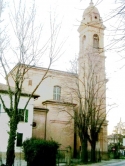
Santuario di Madonna del Pilar (Castenaso, Italia) (Castenaso, Italy)
In four years the sanctuary that will eventually be embellished and expanded, endowed with a beautiful bell tower on design Gulli, almost current form arises. In this tem...