


Strict Standards: Declaration of McalendarControllerMCalendar::display() should be compatible with McalendarController::display($cachable = false, $urlparams = false) in /home/nrnvguvu78sn/public_html/components/com_mcalendar/controllers/mcalendar.php on line 0
Strict Standards: Only variables should be passed by reference in /home/nrnvguvu78sn/public_html/components/com_mcalendar/controllers/mcalendar.php on line 22
Strict Standards: Only variables should be passed by reference in /home/nrnvguvu78sn/public_html/components/com_mcalendar/controllers/mcalendar.php on line 23
Strict Standards: Only variables should be passed by reference in /home/nrnvguvu78sn/public_html/components/com_mcalendar/controllers/mcalendar.php on line 24
Strict Standards: Only variables should be passed by reference in /home/nrnvguvu78sn/public_html/components/com_mcalendar/controllers/mcalendar.php on line 25
Strict Standards: Only variables should be passed by reference in /home/nrnvguvu78sn/public_html/components/com_mcalendar/controllers/mcalendar.php on line 26
Notice: Undefined property: stdClass::$name in /home/nrnvguvu78sn/public_html/components/com_mcalendar/models/shrines.php on line 17
Related Books
Virgen de Suyapa
Notice: Undefined property: stdClass::$state in /home/nrnvguvu78sn/public_html/components/com_mcalendar/views/detail/tmpl/default.php on line 95
Suyapa, Honduras (1747)

Discovery
Veneration
References
- ^ Article on the virgin
- ^ Amid a Crisis, Hondurans Heap Large Hopes on a Tiny Religious Icon The New York Times (www.nytimes.com). Retrieved 2012-08-13.
- Barceló Morey, Jose. 2000. La Inmaculada Concepción de María en Honduras: La Inmaculada Concepción de Suyapa, Patrona de Honduras. San Pedro Sula: Editorial/Librería Coello
- Valladares B., Juan R. 1946. La Virgen de Suyapa (historia documentada). Tegucigalpa: Tallereres Tipo-Lito.
External Links
- Official Catholic church site Spanish
- Virgin of Suyapa visits Honduran suburb devastated by massacre
- Article in Spanish on sources of the story
-----------------
The tiny image of Our Lady of the Conception of Suyapa was found by a humble young peasant on a Saturday in January 1747. Alejandro Colindres, and Lorenzo Martinez, an eight-year-old boy, were returning to the village of Suyapa, tired from working all day gathering corn. They were half way there when night fell as they reached the ravine. This seemed to them like a good place to spend the night and they lay down on the hard ground. Right away Alejandro felt that something, apparently a stone, was preventing his finding a comfortable position for his back. In the dark, he picked it up and threw it far away. Strangely enough, on lying down again he felt the same discomfort, but - intrigued- this time he did not throw it, instead he put it away in his knapsack. At day break he discovered that the mysterious object was a charming small image of Our Lady carved in cedar wood.
Our Lady of Suyapa measures only six and a half centimeters. It is a very old carving, probably the work done with devotion by an amateur artist. Her angelic looks reflect the nobility of the native race. It is a dark image with an oval face and shoulder length straight hair: her tiny hands are joined together in a prayerful attitude. The original painted color of her robe is light pink, which now can be seen slightly, covered by a dark cloak trimmed with golden stars and adorned with valuable jewels. The object of great veneration on the part of the Honduran people, the image rests on a solid silver sphere, and appears surrounded by a circle of silver rays, which evoke "the woman dressed by the sun" mentioned in the Book of Revelation.
In 1925, Pius XIIl declared Our Lady of Suyapa patroness of the Republic of Honduras, and February 3 was chosen as her feast day with proper Mass and office. The first shrine was blessed in 1780 and the first notable attested miracle, occurred in 1796. The present enormous church, with space for the
multitude of pilgrims who visit Suyapa, was visited by John Paul II in 1983. In the land of the poor, this sanctuary of Santa Maria de Suyapa is located in one of the humblest parts of the city.
Source: http://campus.udayton.edu/mary/resources/engfour.html#els
Shrines
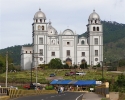
Basílica de Suyapa (Suyapa, Honduras)
Basilica of Our Lady of Suyapa Patron or Notre Dame de Suyapa In the eighteenth century was found the image of the Virgin of Suyapa, by Alejandro Colindres, the first im...