


Strict Standards: Declaration of McalendarControllerMCalendar::display() should be compatible with McalendarController::display($cachable = false, $urlparams = false) in /home/nrnvguvu78sn/public_html/components/com_mcalendar/controllers/mcalendar.php on line 0
Strict Standards: Only variables should be passed by reference in /home/nrnvguvu78sn/public_html/components/com_mcalendar/controllers/mcalendar.php on line 22
Strict Standards: Only variables should be passed by reference in /home/nrnvguvu78sn/public_html/components/com_mcalendar/controllers/mcalendar.php on line 23
Strict Standards: Only variables should be passed by reference in /home/nrnvguvu78sn/public_html/components/com_mcalendar/controllers/mcalendar.php on line 24
Strict Standards: Only variables should be passed by reference in /home/nrnvguvu78sn/public_html/components/com_mcalendar/controllers/mcalendar.php on line 25
Strict Standards: Only variables should be passed by reference in /home/nrnvguvu78sn/public_html/components/com_mcalendar/controllers/mcalendar.php on line 26
Notice: Undefined property: stdClass::$name in /home/nrnvguvu78sn/public_html/components/com_mcalendar/models/shrines.php on line 17
Related Books
Santa Maria in Trastevere
Notice: Undefined property: stdClass::$state in /home/nrnvguvu78sn/public_html/components/com_mcalendar/views/detail/tmpl/default.php on line 95
Rome, Italy

OUR LADY BEYOND THE TIBER Tradition speaks of a chapel dedicated to Our Lady located beyond (read across) the Tiber River, at Rome established by Pope St. Calixtus I, most likely around the beginning of his reign that ran from 218 to 222 AD The title is celebrated annually on January 9. The site is the now location of the Basicilica di Santa Maria in Trastevere. See the title Santa Maria in Trastevere.
----
MADONNA DELLA CLEMENZA The title takes its name from a relatively large encaustic painting on wood that stands above the altar in the Altemps Chapel in the church of Santa Maria in Trastevere in Rome.* (For more on the church, see the general consensus is that it was commissioned by Pope John VII (March 1, 705—October 18, 707). The image depicts the Blessed Mother, enthroned, with the Christ Child on her lap, both looking forward, with an angel on either side. Kneeling with his head about at Mary’s left knee is the papal portrait. The title is also known as the Madonna of Clemency; Our Lady of Clemency; and Madonna of Mercy. It is also sometimes referred to as Santa Maria in Trastevere, which has caused considerable confusion. In fact, almost everything having anything to do with the church of Santa Maria in Trastevere is a source of confusion which will soon become evident if it has not already. At St. Clement’s Episcopal Church in Philadelphia, the Shrine of our Lady of Clemency, where a Novena is said daily in her honor, was dedicated on March 25, 1943. Her feast day is celebrated on September 24th. There, Our Lady is shown “clothed with the sun, the moon under her feet, and on her head a crown of twelve stars,” as, according to Revelation (12.1), Saint John was privileged to see her in Heaven. *The Altemps Chapel is also home to rather unusual frescoes from 1588 depicting the Council of Trent.
-------
MADONNA DI LIDDA The title was established at Monte Mario northwest of Rome where the image is preserved in the church and monastery of Our Lady of the Rosary.* At 455 feet, Monte Mario is the highest hill of Rome; but it is not one of the fabled Seven Hills of Rome because it outside the limits of the city. The title is also known as Madre di Dio di Lidda (present-day Lod in Israel); Mother of God of Lydda; Madonna di Lidda; Madonna di San Sisto (Sixtus); Madonna Nera di Lidda; and Madonna di Roma; also, Rimskaja; Die Römische; Liddskaja; and Die Lyddische. Legend says that the Apostles Peter and John, after converting a large crowd of people at Lydda, erected a church that they consecrated to the mother of God. They asked Mary to visit the chapel; but she replied: “go with joy, because I will be with you.” On their return to the chapel, they found an image of Mary that had been miraculously created. Later, Mary visited the chapel and blessed the image and awarded the image the grace of miraculous powers. As the legend goes, in the 4th century, Julian Apostate ordered the image destroyed, but all attempts to destroy the image met with failure. For the next three centuries, the image was revered and venerated throughout the East. As it was, the first acts of the iconoclasm (the deliberate destruction of religious images) that erupted in the Eastern Church in the late seventh century and continued through most of the eighth century.** Saint Germanus, Patriarch of Constantinople from 715-730, was dismissed from office in 730 and exiled for his resistance. It is said that Germanus cast the miraculous icon into the sea and that Pope St. Gregory II, alerted by a dream, stood on the shores of Italy with the clergy and prayed out to sea.** When Gregory had finished his prayer, the image arose from the sea and rested in his hands, after which he carried it in procession to Rome. The history and legend of Madonna di Lidda is been inextricably entangled with the legends of Santa Maria in Trastevere; Virgin Salus Populi Romani; and Madonna della Clemenza, each of which is treated separately. Dates of origin and key dates along the way help to differentiate what get lost in the particulars. *Monastèro di Santa Maria del Rosario e della Febbre, also known as Santa Maria Rosario. The image itself is known as an “acheropita” meaning, “not made by human hand.” It is also said that the image was designed by St. Luke and painted by the hands of angels. Modern scholars have classified and dated the image as Byzantine in origin from prior to the end of the fifth century. **Most reports identify the pope as Pope St. Gregory I “the Great,” whose papacy extended from 590 to 604, before the time of Iconoclasm. During this time period, the Pontiffs were St. Gregory II (715-731) and St. Gregory III (731-741).
----------
SANTA MARIA IN TRASTEVERE The title takes its name from the ancient basilica church and monastery located in the Trastevere neighborhood of Rome, whence the name. It is generally believed that Pope Callixtus (217-222) founded the first Christian church on this site as early as the third century (see the title Our Lady Beyond the Tiber). Legend says that the image of the Madonna and the infant Jesus in the Byzantine style enshrined in the church and attributed to St. Luke was placed there by St. Helena, who brought the icon to Rome in 352, around the time the forerunner of the present church was constructed. Santa Maria in Trastevere is venerated for the deliverance of the people from epidemics. The image is also referred to as a “BV in SS Domenico e Sisto” (see below). In the year 591 AD, a plague descended upon Italy, and Pope St. Gregory the Great led a solemn procession through the streets of Rome carrying an icon of the Mother of God from the church in Trastevere and ending at Hadrian’s Tomb, now called Castle San Angelo. An angelic choir was heard to be sing the Resurrection hymn: Regina coeli, laetare, alleluia; Quia quem meruisti portare, alleluia; Resurrexit sicut dixit, alleluia. 237 to which the Pontiff added Ora pro nobis Deum, alleluia . (Queen of Heaven, rejoice, alleluia; for He whom you did merit to bear, alleluia; has risen as He said, alleluia; pray for us to God, alleluia.) At those words the plague ended. The event, celebrated each year on February 24, is known as the feast of the Procession of Pope St. Gregory with a Painting of Our Lady by St. Luke. Another legend says that the icon carried by the St. Gregory was the Salus Populi Romani Icon , but that image cannot be dated earlier than the eighth century. Three centuries later, Pope Sergius III (904-911) had the painting moved from the convent of nuns at the monastery of St. Mary in the Temple and placed in the Basilica of St. John Lateran. Legend has it that the picture miraculously found its way back to the monastery of its own accord. Pope Honorius had wished to assemble nuns scattered in monasteries through Rome at St. Sixtus and make profession to blessed Dominic. The Gilbertines at St. Mary in the Temple resisted. After considerable wrangling, they agreed on condition that their miraculous icon accompanied them and remained at St. Sistus, and there no repeat of the affair involving the Lateran Basilica. In 1218 or 1219, St. Dominic, with the approval of the Vatican, personally transferred the painting from the monastery to the old church dedicated to St. Sixtus II, who was martyred in 258. Pope Honorius III had granted the church, San Sisto Vecchio, located on Via Appia in the old patrician quarter of the city, to St. Dominic and the Order of Friar Preachers. The transfer of the painting and the imposition of vows constituted the last steps in the establishment of the second house of religious women living under the rule of St. Dominic. The origins of the present basilica are believed to have the popes Calixtus I, Julius I, and Cornelius that had been exhumed from the catacombs. Renovations continued until the church was totally rebuilt in the 12th century by Pope Innocent II (1130-1143), using materials from the ancient Baths of Caracalla. Most of the present building dates from this period. The portico was added in the 19th century. The church holds a relic of Saint Apollonia and a portion of the Holy Sponge. Also see the title Our Lady Beyond the Tiber. *St. Helena (mem. August 18), the mother of Constantine the Great, lived her last years in Palestine where she died c. 330. Her body was subsequently brought to Rome. The last coins that bore her name, Flava Julia Helena, were minted in 330. For more on St. Helena see Our Lady of the Cross.
Source: Mary In Our Life: Atlas of the Names and Titles of Mary, The Mother of Jesus, and Their Place in Marian Devotion - by Nicholas Santoro
Shrines
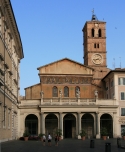
Basiilica di Santa Maria in Trastevere (Rome, Italy)
SANTA MARIA IN TRASTEVERE The title takes its name from the ancient basilica church and monastery located in the Trastevere neighborhood of Rome, whence the name. It is g...