


Strict Standards: Declaration of McalendarControllerMCalendar::display() should be compatible with McalendarController::display($cachable = false, $urlparams = false) in /home/nrnvguvu78sn/public_html/components/com_mcalendar/controllers/mcalendar.php on line 86
Strict Standards: Only variables should be passed by reference in /home/nrnvguvu78sn/public_html/components/com_mcalendar/controllers/mcalendar.php on line 22
Strict Standards: Only variables should be passed by reference in /home/nrnvguvu78sn/public_html/components/com_mcalendar/controllers/mcalendar.php on line 23
Strict Standards: Only variables should be passed by reference in /home/nrnvguvu78sn/public_html/components/com_mcalendar/controllers/mcalendar.php on line 24
Strict Standards: Only variables should be passed by reference in /home/nrnvguvu78sn/public_html/components/com_mcalendar/controllers/mcalendar.php on line 25
Strict Standards: Only variables should be passed by reference in /home/nrnvguvu78sn/public_html/components/com_mcalendar/controllers/mcalendar.php on line 26
Notice: Undefined property: stdClass::$name in /home/nrnvguvu78sn/public_html/components/com_mcalendar/models/shrines.php on line 17


Virgen del Milagro / Our Lady of the Miracle - Mazarrón, Murcia, Spain
Notice: Undefined property: stdClass::$state in /home/nrnvguvu78sn/public_html/components/com_mcalendar/views/detail/tmpl/default.php on line 95
Rome, Italy (1585)

Description
In Ratisbonne's own words: "I was scarcely in the church when a total confusion came over me. When I looked up, it seemed to me that the entire church had been swallowed up in shadow, except one chapel. It was as though all the light was concentrated in that single place. I looked over towards this chapel whence so much light shone, and above the altar was a living figure, tall, majestic, beautiful and full of mercy. It was the most holy Virgin Mary, resembling her figure on the Miraculous Medal. At this sight I fell on my knees right where I stood. Unable to look up because of the blinding light, I fixed my glance on her hands, and in them I could read the expression of mercy and pardon. In the presence of the Most Blessed Virgin, even though she did not speak a word to me, I understood the frightful situation I was in, my sins and the beauty of the Catholic Faith."
Approval
In Feb 1842 the Vatican held a canonical investigation of the circumstances surrounding Alphonse's conversion. After lengthyinquiry and many depositions, it concludes that his sudden conversion was entirely miraculous; an act of God wrought through the powerful intercession of the Virgin. In May 1842, only a few months after the apparition, a painting of the Madonna of the Miracle was placed for veneration in exactly the same spot and in the same form as She appeared. The canvas was painted by the artist Natale Carta, who according to tradition, followed the directives of Ratisbonne himself. In the same year, after a formal inquest about the apparition of January 20, the Vicar General of Pope Gregory XVI, Cardinal Patrizi, declared on June 3, 1842, that it was a divine miracle operated through the intercession of the Blessed Virgin Mary, and permitted the publication and spread of texts recording the miracle.
Shrines
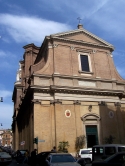
Sant'Andrea delle Fratte (Rome, Italy)
Sant'Andrea delle Fratte is a 17th-century basilica church in Rome, Italy, dedicated to St. Andrew. The Cardinal Priest of the Titulus S. Andreae Apostoli de Hortis is En...