


Strict Standards: Declaration of McalendarControllerMCalendar::display() should be compatible with McalendarController::display($cachable = false, $urlparams = false) in /home/nrnvguvu78sn/public_html/components/com_mcalendar/controllers/mcalendar.php on line 0
Strict Standards: Only variables should be passed by reference in /home/nrnvguvu78sn/public_html/components/com_mcalendar/controllers/mcalendar.php on line 22
Strict Standards: Only variables should be passed by reference in /home/nrnvguvu78sn/public_html/components/com_mcalendar/controllers/mcalendar.php on line 23
Strict Standards: Only variables should be passed by reference in /home/nrnvguvu78sn/public_html/components/com_mcalendar/controllers/mcalendar.php on line 24
Strict Standards: Only variables should be passed by reference in /home/nrnvguvu78sn/public_html/components/com_mcalendar/controllers/mcalendar.php on line 25
Strict Standards: Only variables should be passed by reference in /home/nrnvguvu78sn/public_html/components/com_mcalendar/controllers/mcalendar.php on line 26
Notice: Undefined property: stdClass::$name in /home/nrnvguvu78sn/public_html/components/com_mcalendar/models/shrines.php on line 17
Notice: Undefined variable: event in /home/nrnvguvu78sn/public_html/components/com_mcalendar/views/detail/tmpl/default.php on line 43
Notice: Trying to get property of non-object in /home/nrnvguvu78sn/public_html/components/com_mcalendar/views/detail/tmpl/default.php on line 43
Notice: Undefined variable: event in /home/nrnvguvu78sn/public_html/components/com_mcalendar/views/detail/tmpl/default.php on line 43
Notice: Trying to get property of non-object in /home/nrnvguvu78sn/public_html/components/com_mcalendar/views/detail/tmpl/default.php on line 43
Notice: Undefined variable: event in /home/nrnvguvu78sn/public_html/components/com_mcalendar/views/detail/tmpl/default.php on line 44
Notice: Trying to get property of non-object in /home/nrnvguvu78sn/public_html/components/com_mcalendar/views/detail/tmpl/default.php on line 44
Notice: Undefined variable: event in /home/nrnvguvu78sn/public_html/components/com_mcalendar/views/detail/tmpl/default.php on line 44
Notice: Trying to get property of non-object in /home/nrnvguvu78sn/public_html/components/com_mcalendar/views/detail/tmpl/default.php on line 44
Related Books
La Virgen de Belén
Notice: Undefined property: stdClass::$state in /home/nrnvguvu78sn/public_html/components/com_mcalendar/views/detail/tmpl/default.php on line 95
San Juan, Puerto Rico
Commemorated on Third Sunday Feast of the Epiphany

The Virgin of Bethlehem or milk Virgin who came to Puerto Rico is an oil on board from Flanders . Specialists in XV century art attributed the authorship of the school Flemish panel painter Brussels Rogier van der Weyden or some unnamed disciple belonging to school teacher.
The image is painted on wood, as a canvas. The average image size has venerable face, fair complexion, hair loose, rays around the head, slanted eyes happily the babe wrapped in swaddling clothes. His chest is bare, with a few drops of milk led to the child's lips. This, lying in the arms of his mother, looks like sweetness. The Virgin is dressed in a blue tunic and cloak of red or crimson. At the back is a kind of dark grove mountain way. It is a landscape that represents the flight into Egypt. He arrived in San Juan between 1511 and 1522. It measures 55 by 37 cm.
Because of the English invasions of 1598 and 1625 Dutch was hidden and miraculously found according to tradition. In 1714 he was privileged altar in the Cathedral of San Juan.
During the siege of Abercromby (1797), Bishop Zengotita gave orders that every day prayers will be held in the parishes of the city. Its participants, mainly women, singing hymns and litanies and carried in the hands candles or torches. The picture of Our Lady of Bethlehem was paraded in procession through the city for help. Legend has it that the invader was an army of men with torches. Frightened by this stunning view, decided to retire and not to attack the city. Thus, the protection of the city was attributed to Our Lady of Bethlehem, which was regarded by the people "protector of the city". Today exists in Caleta de San Juan, near the old wall and facing the Bay of San Juan, imposing sculpture called "supplication", which perpetuates this memorable chapter in the history of Puerto Rico.
Fruit of personal devotion and people sanjuanero, Puerto Rican painter José Campeche reproduced it many times. Some reproductions of the original Our Lady of Bethlehem are in the National Gallery of Old San Juan and the other in the Museum of the University of Puerto Rico in Rio Piedras.
The first Puerto Rican Bishop Juan Alejo de Arizmendi was devoted. In 1806 granted forty days' indulgence to those who pray one Hail before the image, praying to God for the purpose of the Church.
The Virgin of the original Bethlehem disappeared from the Church of San José del Viejo San Juan (Old St. Thomas Church of the Dominicans) in 1972. The December 13, 2011 was brought from Belgium to Puerto Rico a facsimile copy of the original. Was presented to the people of Puerto Rico on January 3, 2012. Several fabric reproductions have been placed in various parishes in the metropolitan area and the island.
Origin of the iconographic tradition
According to tradition, Mary and her Son decansaron in a cave, called the Milk Grotto, near the spot where now stands erected the Church of the Nativity. The tradition adds that there nursed the child Virgin. A drop of milk fell on the stone of the cave, and it became white. During the first centuries, this chalk, diluted in water, taking the appearance of milk and used as relic.
The tradition dates back milk, on the other hand, in the first centuries of Christianity. A neophytes were given to drink milk mixed with honey, which in the primitive churches of Egypt, Rome and North Africa was solemnly blessed on the vigils of Easter and Pentecost. Milk with honey symbolized the union of the two natures in Christ. The custom of giving milk and honey to the newly baptized did not last long but survived the artistic representation.
Some iconographic
In the catacombs of Priscilla in Rome contained a pictorial representation of the Virgin, made in the second century. It is likely to be a Virgin infant. The catacombs there are other symbols referring to milk.
In Chilandari Monastery Church of Mount Athos , Greece, was worshiped a Virgin de la Leche, in the Byzantine style of the eleventh and twelfth centuries, called Panagia Galaktotrophusa.
An inscription of the thirteenth century, in one of the images of the Virgin (which could be a Virgin of the Milk), in the city of Saydnaya, near Damascus, figure in Latin: oleum ex ubere Genitris Hoc Dei Mariae Virginia emanavit in loco , qui vocatur Sardinia, genitilitas ubi est, ex imagined lignea "This oil flowed from the breast of the Virgin Mary, Mother of God, carved in wood, which happened in a place called Sardinia Gentiles". This image was taken from Constantinople to Saydnaya, probably in the eleventh century. And until after the fourteenth century, oil or milk was distributed. This icon was influential. The Templars distributed among the pilgrims substance in many countries. It is very likely that this famous shrine of Saydnaya, which was a place of pilgrimage for Christians of East and West, is the source (or one of the main sources) the pictorial theme.
Representations of the Virgin in the Netherlands
Responding to the devotion and worship of the Virgin in Europe during the Middle Ages, the Flemish primitives multiplied images of Mary. In the late fifteenth, sixteenth and until the Council of Trent (1545-1563), had height in the Netherlands representations of the Virgin of milk.
Rogier van der Weyden, the alleged perpetrator of the Virgin of Bethlehem, was a Flemish painter of fame and prestige in the fifteenth century. He left his hometown in 1435 Tournai to settle in Brussels, where he was appointed painter to the city. Not retain any signed author's work.
Interest in his art was not limited to the Brussels region. Received commissions from distant regions such as Italy, Savoy, the Rhineland and Spain.
Table may happen to some Flemish Dominican convent in Spain and little later accompany him on his trip to the Dominican friars founders of the first convent in Old San Juan.
[1]
References [ edit · edit code ]
Cuesta Mendoza, Antonio, Historical Library, Vol I, 1508-1700, Printing "Art and Cinema", Dominican Republic 1948, p. 298-299.
Delgado Mercado, Osiris, "Campeche, the first major Puerto Rican painter" in Voices of culture. Testimonials about people, culture, institutions and historical events in Puerto Rico and the Caribbean, and Central Voice Foundation, San Juan 2006, p. 1-12.
Delgado Mercado, Osiris, José Campeche. The concept invention and sources of his art training, Puerto Rican Athenaeum, Hato Rey 1990.
Friedländer, Max, The Master of Flémalle and Rogier van der Weyden. The Flemish Primitives, Peters, Leuven 1967.
Norbert Ubarri, Michael, "The Virgin of Bethlehem, where is it?" Clarity (10 to 16 April 2008), p. 16 and 29.
Rodríguez León, Mario, Bishop Juan Alejo de Arizmendi before the revolution and the beginning of the emancipation of Latin America and the Caribbean, Editorial Friendly Home, Dominican Republic 2003, p. 133.
Rodriguez, Jorge, "There are new works of Campeche, Oller and Albizu", The Spokesman (May 6, 2008)
Trains, Manuel, Maria. Iconography of the Virgin in Spanish art, Plus-Ultra, Madrid 1946.
"To deal with the deprivation of the Altars of Our Lady of Belen and Altagracia, and what happened on Good Friday Procession", Proceedings of the Cathedral Chapter, fol. 100v-103v
Shrines
Caleta de San Juan (San Juan, Puerto Rico)
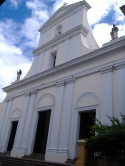
The Cathedral of San Juan Bautista is the Roman Catholic cathedral of the Archdiocese of San Juan de Puerto Rico. The cathedral is one of the oldest buildings in San Juan...